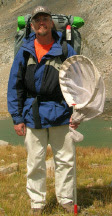
On Friday and Saturday, the Indiana Dunes hosted this year's National Geographic BioBlitz. In a typical bioblitz, scientists converge on a particular area and intensively sample all of the biodiversity that they can find in a 24 hour period. This year, we attempted to demonstrate how few species can turn up on an extremely diverse site when the bioblitz takes place during a torrential rainstorm. The bioblitz began at 12:00 noon on Friay, and the rains began before 1:00. The last rains fell at around 9:00AM on Saturday. We got about 3" of rain in that time.

Drifts of lupine in the savanna at Howes Prairie
The Indiana Dunes is an incredible site, with lots of ecological diversity and many rare species. I was hoping to be able to take some nice digital photos of Olympia Marblewing butterflies (didn't happen). I had signed up for two events. On Saturday afternoon, I was to sample terrestrial insects at Howes Prairie (actually more of a savanna than a prairie). I was pleased with this site assignment, because there is an endangered butterfly called the Karner Blue there. I actually got very cold and wet while finding about a dozen arthropods. Not a dozen species, mind you, a dozen individuals. We found them by turning over logs and looking under bark.
 A syrphid fly we found under loose bark on a dead tree
 One of two Six-spotted Tiger Beetles that we found
The afternoon's tally included two tiger beetles, a few syrphid flies, some wood roaches, a June beetle, a millipede and a couple of centipedes, all collected under rocks or bark.

Note how wet this tiger beetle is
Finally, the rain became so heavy, we decided to call it quits about an hour early. By this time, I was soaked to the skin in spite of the fact that I was wearing a good Goretex jacket.
 Soaked! Photo by Ann
The BioBlitz provided dinner for the scientists. We were so cold and wet, however, that Celeste, Jamie, Robin and I opted to go inside a warm restaurant and have Mexican food (and Margaritas!). Despite being indoors, I shivered for most of the meal.

My blacklighting setup at the Paul Douglas Nature Center
In the evening (8:00 PM-Midnight) I was scheduled for blacklighting at Miller Woods. We opted to set up the black lighting rig on the back of balcony of the Nature Center. This kept us (and my power supply with exposed electrodes) out of the rain. If you don't count tiny midges and gnats, a total of six insects showed up at the sheet: three scarab beetles (2 species), a Geometrid moth and a couple of stoneflies. It was still cold, and my clothes did not have a chance to dry. But we were out of the rain, and the company was good (Melinda even brought cookies!). Because we were in a National Park, we did nbot get to demonstrate a completely authentic black lighting event. Even worse than the bad weather, there was no beer.

Scarab #1 at the sheet
 Scarab #2 at the sheet
 The Honest Pero (Pero honestaria)- a Geometrid Moth
By 10:30, we decided to call it a night. The rain was still falling steadily, but my sleeping bag was dry, and I had secured one of the bunks in a cabin. I slept the sleep of the dead that night, warm and dry for the first time in over 12 hours.
Labels: BioBlitz, Moths, Tiger Beetles, Weather


 Over at Halibut Point we saw the strangest water creatures of the day. Surfers in a nor'easter off of a very rocky shoreline are a sign of complete insanity.