Gossamer Tapestry

Reflections on conservation, butterflies, and ecology in the nation's heartland

Sunday, March 21, 2010

Return to Florida

Yeeps, I haven't even finished blogging about my last trip to Florida and I'm back down here again. I'm here for part 3 of the Imperiled Butterfly Conservation and Management workshop.

I started out with the trip by meeting a fellow blogger named Tony. Kathie will find this particularly amusing- yes, this is your brother-in-law. We went for a delightful nature walk at Hugh Taylor Birch Park State Park in Ft. Lauderdale and went out for a couple of drinks together. A charming and delightful man. We wanted to take a photo to post and forgot to do so. Ah, well,

I'm pleased to say that the weather has been far nicer so far than it was a few weeks back. I came down a couple of days early in the hopes of getting in some better entomology than I managed in February. Although it has been better, the bugs are still suffering the aftereffects of a very cold winter. In February, I was at Fackahatchee Strand State Park over near Naples and managed to get photos of a caterpillar of the Little Metalmark (Calephelis virginiensis). It's a very close relative of the Swamp Metalmark, and my photos are the first of the caterpillar to be posted on BugGuide.


Little Metalmark (Calephelis virginiensis) Caterpillar

This time around I wwanted a picture of the adult. I succeeded- after a fashion. I'm not thrilled with the quality.


Little Metalmark (Calephelis virginiensis)

Some of the other butterflies were more photogenic. I especially liked the shot that I got of the Twin-spot Skipper.

Twinspot Skipper (Oligoria maculata)

Dragonflies were also putting in an appearance. There weren't huge numbers, but a few posed for me.


Forktail Damselfly (Ischnura sp.)


Halloween Pennant (Celathemis eponina)

Ther were even a few vertebrates that posed for us. Yeah, cute cute, blah blah blah.


Green Treefrog (Hylas cinerea)

Over by Naples I connected up with other blogging friends- the Thingfishes! We went on an unsuccessful expedition for tiger beetles we had a great seafood dinner. It has been a very enjoyable trip so far.


Blogging friends (Thingfish sp.)

Labels: , , , ,

Monday, August 24, 2009

Full Weekend


Ichiban Eggplant and Roma Tomatoes

It was such a full weekend that I never got to the Fen. That's pretty surprising at this time of the year. Things at home had me tied down. We spent a lot of time working on the screened porch. That project has been underway for a bunch of years now- and we just about finished up. I'll give it a whole blog post later in the week.

The vegetable garden is producing full tilt at the moment, and I spent a lot of the weekend putting food by. I froze three pints of eggplant and two of beans. I dried a bunch of Roma tomatoes, and went to the farm stand for corn. I got four pints of bicolored sweet corn in the freezer. I'm feeling very virtuous right now.


Sweet Corn!

It wasn't all indoor stuff, however. As I mentioned recently, we have 300 swamp metalmark larvae in the lab right now. That's a lot of mouths to feed. I collected a bit of swamp thistle, which is the caterpillar food plant.


Swamp Thistle (Cirsium muticum)

Swamp thistle is a biennial. It grows a rosette the first year, and in the second year it blooms, sets seed, and dies. I collect the first year rosettes to feed the caterpillars. I get them from a mowed area on the edge of a bike path just up the street from my house.


The bike path. The thistle is mostly on the right side.


First year thistle rosette

Summer is definitely passing by. I saw a lot of fall wildflowers. Sunflowers were abundant, but there were some other, more interesting fall flowers.


Tall White Lettuce (Prenanthes alba)


One of the Fireweeds (Epilobium sp.)

I even saw zigzag goldenrod, which Andy and Adam were discussing with me last weekend. I took a picture so they can see what it looks like.


Zigzag Goldenrod (Solidago flexicaulis)

After digging up one of the thistles, I felt a tickling sensation on my left wrist. A mating pair of stick insects had climbed aboard.


Northern Walking Stick (Diapheromera femorata)

You can see the much smaller male on the lower left of the female.

The problem with very full weekends is that Monday always seems to come around particularly quickly.

Labels: , , ,

Tuesday, April 21, 2009

Spring Hymenoptera


Some of the most conspicuous insects at the Fen last weekend were bees and ants. In the recently burned over areas, the ant mounds become very visible. The ants, of course, were largely unharmed by the fire because they are safely underground. In a prairie fire, the soil temperature changes little just a couple of centimeters below the surface.

I'm pretty sure that these ants are in the genus Formica. They were very active in the warm temperatures on Saturday.

Meanwhile, willows are producing abundant pollen at the moment. The bees really like it. There were hundreds of bees from several species all over this black willow, though they were hard to photograph.

Labels: , ,

Monday, April 06, 2009

Carrion - It's What's for Dinner


Deer carcass remains. Note the relatively intact hoof in the lower midsection.

Last fall and winter, FC posted a whole series of photos documenting the decomposition of a dead deer. Things work a bit differently here up in the Arctic wastelands of Illinois. A deer that died over the winter got covered by snow. The cold temperatures meant that decay by both bacterial and insect processes was slowed. The coyotes definitely got in on the decomposition event, but they are far less relentless than the bugs (both insect and microbial). The result was that parts of the carcass became somewhat freeze dried over the winter.
I've been watching this carcass over the past couple of weeks as it has emerged from the snow.


Carrion beetle crawling over the deer hoof

On Saturday, we had very nice weather and Leon and I were out at the Fen. Even though the temperatures were only in the low 50s, carrion-feeding insects were in evidence around the deer remains. Blowflies in the genus Calliphora are often the first insects to arrive at a carcass. They become active very early in the spring. There were only two that were present at this carcass. Blowflies seem to prefer a carcass that it in the very early stages of decomposition. They lay their eggs in the tissues that are still soft- eyes and other mucosal tissue- and the result is often a large and very active mass of writhing maggots. That will not happen with this deer- the decomposition is too far along.


A large blowfly (probably genus Calliphora) at the carcass


A much smaller blowfly. I'm not much of a dipterist, so I'm not sure
whether these two flies are the same species or not.


I was very surprised to see not one but two species of carrion beetles (Silphidae) at the carcass, in some numbers. These beetles tend to show up somewhat later in the decay process. My surprise was that they were out this early. It's yet another sign of spring: the trees are budding, the flowers are blooming, the carrion is decaying.


Carrion beetle (Oiceoptoma inaequale)


Carrion beetle (Oiceoptoma noveboracense)

Labels: ,

Thursday, March 19, 2009

John the Baptist Bread

Bug Girl is in a pickle. She can't find her copy of Entertaining with Insects, and needs to do just that over the weekend. Mark and Rodger gave me my very own copy for Christmas last year. As I am always eager to help a damselfly in distress, here is the recipe she wants. It's named for John the Baptist's reported diet of locusts and wild honey (though I'm at least partly persuaded by the camp that believes that he was eating carob, the pods of a type of locust tree).

Ingredients

2 1/2 cups flour
1/2 cup honey
3 1/2 tsp baking powder
1 tsp salt
3 Tblsp vegetable oil
1 cup milk
2 eggs
1 cup dry roasted crickets

Grease and flour a loaf pan (9 x 5 x 3 inches). Add all ingredients except crckets in a large mixing bowl. Beat on medium speed for about 1/2 minute or until smooth. Add crickets and stir until well mixed. , then pour into the pan. Bake at 350° 40-55 minutes until a toothpick comes out clean when inserted into the center of the bread. Slice while hot. Serve with sweet butter a l'orange.

Sweet Butter a l'orange

1/2 lb. sweet butter, softened
2 Tblsp. grated orange rind (For an added touch, soak the rind in your favorite cordial)

Mix with fork, place in serving dish and refrigerate.

Dry Roasted Crickets

Spread fresh, frozen and cleaned crickets on paper towels on a cookie sheet. Bake at 200° for 1-2 hours until desired state of dryness is reached. Check state of dryness by attempting to crush the crickets with a spoon.

Labels: ,

Monday, February 09, 2009

Windley Key


Hammock at Windley Key

I am in Ft. Lauderdale right now. Leon is safely back in Chicago. We drove from Key West to Miami yesterday. There was a bit of extra time, so we decided to visit a spot we have never explored before: Fossil Reef State Park at Windley Key. A lot of the land that makes up the Keys consists of fossilized coral reefs. The fossil reefs at the park are especially visible because this area was used as a quarry by Mr. Flagler in the early 1900s when he was creating the Overseas Railroad that ran the length of the island chain.


Gumbo Limbo (Bursera simaruba)

We chose the Hammock Trail to explore. The guide at the visitor center was very pleasant and hlpful, offering us a trail guide to take with us. It contained a lot of tree identification. I was hoping to learn to identify more of the hammock trees. I've heard many of their names- Pigeon Plum, Jamaican Dogwood, White Stopper- and feel hopeless about identifying most of them. Gumbo Limbo is easy because of its peeling reddish bark. I have also learned to identify Poisonwood. This is paretly out of necessity, as it's a relative of poison ivy and has similar consequences, and partly because it's a distinctive species. I was pleased to learn to identify a shrub called wild coffee (Psycotria nervosa), and the mastic tree (Sideroxylon foetidissimum). I'll confess that I'm still sufficiently confused by the tree species in the hardwood hammock ecosystem that I don't yet feel att home there, even though it's an ecosystem that I really love visiting.


Bagworm Pupa

There were some opportunities for insect photography, but not much time. We saw some striking bagworm cocoons and lots of Eastern Pondwawk dragonflies.


Yet another Eastern Pondhawk

There were a whole bunch of Whitecrossed Seed bugs wandering (and mating) on the sterile sand inside of one of the areas that had been quarried.


Whitecrossed Seed Bug (Neacoryphus bicrucis)

My overall impression of the area? In general, I've been very impressed with Florida's state park system. The park was clean, the trails were well marked, and the interpretation was of high quality. The park contains important remnants of a fragmented ecosstem, and is well-managed in terms of things like invasive species control. Definitely worth a visit. I know I'll be back.

Welcome Nature Blog Network readers. Thanks to Wren for kindly presenting Gossamer Tapestry os this week's featured blog.

Labels: , , ,

Sunday, January 18, 2009

My 10 Insect Moments of 2008

A great idea put forward on the Nature Blogging Network site. They have put out the call for members to recap their top 10 nature posts of 2008. I decided to challenge myself by being a bit more specific than that. Here are my favorite 10 insect posts from last year.


10. Photographing tiger beetles at Wilcox Playa


9. Standing in fresh snow and collecting Cicindela lengi on the same day


8. Learning winter care for butterflies in Seattle and Portland


7. Breeding Purplish Coppers


6. Black lighting in Madera Canyon


5. Collecting and photographing Cicindela suturalis in Puerto Rico


4. Finding the Lichen Grasshopper in Arizona


3. Putting Regal Fritillary larvae to bed for the winter


2. Finding a new population of eastern red-bellied tiger beetles, and later learning that they are a threatened species


1. Successfully breeding Swamp Metalmarks in the lab

Labels:

Thursday, January 15, 2009

Bug Girl on Bug Juice


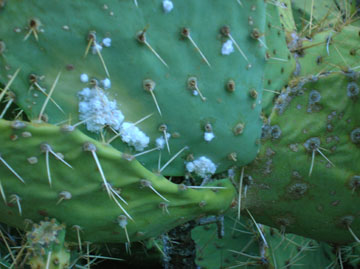
Cochineal (Dactylopius sp.)


There has been a bit of news, and even some controversy lately about a natural colorant called cochineal. The source of cochineal is the bodies of certain species of scale insects that feed on cactus. When crushed, they release a vivid red dye. A while back, I posted about finding cochineal insects during a hike in the Santa Rosa Mountains of California.


Cochineal is used as a colorant in cosmetics (what do you think was in that Jungle Red nail polish?) and red or pink foods like yogurt, juice drinks, and (my favorite) Campari. Some folks have an allergy to cochineal, and this has prompted the FDA to modify rules about labeling foods containing cochineal. A bit of press has resulted, including a fair bit of misinformation and some excessive hand wringing (It's so wrong, we're eating BUGS!!!). Fortunately, the indefatigable Bug Girl is on the case, with an excellent post that puts things right.

UPDATE: I was just contacted with disappointing news from Campari. They have discontinued using cochineal in Campari for about 2 years now. I think that cochineal is a great natural source of red coloring. Please continue enjoying Campari knowing that it now contains synthetic red coloring obtained from coal tar rather than the natural pigment from cochineal. Carry on.

Labels: ,

Thursday, July 31, 2008

Madera Canyon


The conference has really kept me hopping. I've had no time to blog at all. I haven't been reading or commenting on blogs that I regularly read, either. For much of Sunday and Monday I was without internet access. I'm writing this post from Rio Rico, AZ and having awonderful time. Wish you were all here!


Sandy and Me

Sunday was a transition day. I had to pick up fellow entomologist john at the airport in mid afternoon. Fortunately, I was able to have a very pleasant noon time having lunch with Sandy. He's only the fourth blogger that I've met in person, and was a really great guy. We had good food and better conversation at Rosa's.

After I picked john up, we headed off towards Kitt Peak to do some collecting. This was a bit of a bust, because I didn't know that the road up the mountain closed at 4 PM. We got there at about 3:30. We did a bit of collecting just outside the gate and then headed down to Madera Canyon, where we had rented a cabin. This turned out to be a better situation than I had expected. Madera Canyon is well known as a birding hotspot. It also has great insects. Our plan was to check in, go down the moountain for dinner, and return to blacklight. By the time we got checked in, we realized that it would be dark when we returned. We were too hungry to set up the blacklight before eating, so as a compromise we left the back porch light on. Wow. When we returned, the back door was covered with amazing moths and beetles, including a half dozen Chrysina.


Chrysina lecontei

Chrysina are are amazing green scarab beetles. (Bug Girl: "Ooh! Shiny!") There are three species in Arizona, and we namaged to get all 3 black lighting. There were beautiful scarabs, huge fierce looking longhorn beetles and colorful underwing moths. We put the sheet and black light up, and things got even better. It was the finesst blacklighting experience I have had to date.


Chrysina beyeri. Not the best photo, but it shows off the apple green elytra and blue legs.


The aptly named Chrysina gloriosa. The stripes are metallic chrome colored.

On Monday, we spent the day higking up Mt. Wrightson. We did not get anywhere near the summit, mainly because the collecting was so good. I saw my first ever Arizona hairstreak (sorry, no photo), a bunch of beetles and some cool grasshoppers. My favorite was the blue winged grasshopper.


Blue-winged grasshopper (Trimerotropis cyanipennis)


A peek at the blue wings

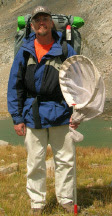
It was an amazing day of insects and plants surrounded by gorgeous views. We even saw a feb birds (Painted Redstart, anyone?) Folks on the trail were intrigued by our butterfly nets, and very friendly. Later, when we got to the conference, two colleagues were snickering at us. they were in Madera the same day we were. They ran into some hikers who said they had seen two other entomologists, one from Denver and one from Chicago. Our colleagues knew that we were just up the hill from them.
More adventures to come (heck, more adventures still happening).

Labels: , , ,

Wednesday, June 11, 2008

Denverensis


Greetings from Colorado. I've been here since very early Saturday morning on an entomological trip. It's been a successful trip, aided by some truly gorgeous weather. My hosts for most of the trip have been John and Mike in Arvada, a suburb of Denver. John is a very accomplished entomologist, and has taught my over 80% of what I know about beetles. I stand in awe of his capabilities, so it's always a treat to go out in the field with him.


Glenwood Canyon and the Colorado River

We spent the weekend up in the high country. Spring is a bit late in the mountains this year. We were unable to do any collecting in the tundra regions- they're still covered with snow. Saturday we met up with Bill, an aquatic entomologist and went collecting on the west slope. Our most successful spots were in Glenwood Canyon. We found lots of nice chrysomelid (leaf-eating) beetles on the willows. John is a chrysomelid expert, so that family always figures heavily when he's around. Also, I managed to take a very nice series of samples from a population of purplish coppers for DNA analysis. My new intern will not lack for things to keep him busy when he starts next week.


Calligrapha multipunctata
A leaf-eating beetle that feeds on willow.

Saturday night we stayed in Breckenridge. Sunday morning we awoke to this:


Fresh snow- June 8, 2008

I offer this for all my readers in the east who spent Sunday sweltering. Obviously this did not make for good collecting. We crossed back over the Continental Divide at Loveland Pass, and were treated to gorgeous vistas of peaks covered with a fresh skim of snow. Magnificent!


In Loveland Pass

Opting to avoid the interstate, we returned via Clear Creek Canyon. There were numerous opportunities to pull off the road and check out the bugs along the creek. We got into the usual kind of trouble.


The usual kind of trouble
Cicindela lengi- a new species for me

Monday we did a grueling hike up above the National Center for Atmospheric Research in Boulder. The collecting and insect photography on that trip were superb. I'll do a post on that later this week.

Labels: , , , ,