Gossamer Tapestry

Reflections on conservation, butterflies, and ecology in the nation's heartland

Friday, May 08, 2009

Migrants Return


Monarch (Danaus plexippus)

A lot of my birder friends are getting all swoon-y over the spring bird migration. I need to step up and celebrate the return of the migrating insects. Last weekend at the Fen, Leon and Kevin saw a very worn Monarch. Unfortunately, I was not with them when it happened, but it's always a delight to hear. A quick perusal of the Journey North website's interactive map reveals that the observation is right in line with what's been reported elsewhere in the country. The monarchs that are getting here right now were born in Texas about a month ago. They are the offspring of the butterflies that spent the winter in the Transvolcanic Mountains of Mexico.


Green Darner (Anax junius) Photo: Wikipedia Commons

It isn't just the monarchs- other insect migrants are arriving as well. It's much less widely known that some dragonflies also migrate. The green darner is the best-studied example. The details are much less well worked out than they are for monarchs. Confounding matters even further, some green darners head south for the winter. Others spend the winter up here in the north. Dragonflies begin their lives as aquatic creatures called nymphs or naiads. In late summer about half of the naiads complete their development. They migrate to the Gulf Coast and Peninsular Florida. The other half of the naiads spend the winter in the northern lakes and ponds. They complete their development the following spring- and emerge at about the same time that the migrants return. Over the past week and a half I've been seeing lots of green darners. Are they returning migrants, or newly emerged from naiads that overwintered? It's hard to say- but it's great to have them back.

Labels: , , ,

Friday, February 08, 2008

Washington Meeting


Karen and a bunch of graphs

I did manage to make it to Washington Tuesday night. I've spent the last couple of days meeting with colleagues to discuss a bunch of data that we are working with. The data concern the monarch butterfly, and they have been gathered through a variety of programs that include people who are not formally trained as scientists. These citizen scientist programs are becoming very trendy. I believe that they have the potential to produce a large quantity of important environmental data. I was there in part because of my work with the Illinois Butterfly Monitoring Network. That's a program that I have run since the late 1980s, and we have a very large data set. Karen Oberhauser is a very well known and respected monarch biologist from the University of Minnesota. Leslie Ries is at the University of Maryland, the location of our meeting. She's the statistician of the group. She and I have been collaborating for several years now, and this is the first time that we got to meet in person.

Our goal was to collate data from a bunch of citizen science programs from around the country. It's a really varied bunch of programs. Some focus on the monarch exclusively, others monitor all species including the monarch. Some monitor adults, others eggs and larvae. Some are national programs. Others have a more regional focus. Would we be able see anything coherent from such a variety of data sets?


Leslie and Doug with an alarmingly large set of correlation analyses that need to be done

The good news is that the outcome was very encouraging. There were some interesting things that we were able to see in the data sets. It feels to me like we arrived at this meeting with a bunch of interesting data, and left with the beginnings of a story. Theres still a lot of statistical anaylsis to be done, but I'm very happy with the outcome so far.

Now, off to the Smithsonian/

Labels: ,

Wednesday, January 30, 2008

Mr. Taron Goes to Washington

At the last minute, I have developed new travel plans that I'm excited about. I'll be headed off to Washington, DC on Tuesday. Actually, I'm going to the University of Maryland in College Park. I'll be meeting with a couple of folks to sort through some of the citizen science data about monarch butterflies and try to get some sort of order out of it. Who knows, maybe we'll be able to actually say something about it. Since I'll be in town, I'll also stop in on a colleague at the Smithsonian who has been developing their upcoming new butterfly exhibit. I've been answering lots of his questions as he has proceeded through the exhibit development process, and I'll probably get a sneak peek before they actually open.

Meanwhile, the promised wild weather here in Chicago in fact materialized:

Temperature at 4PM yesterday: +49° F
Themperature at 5AM this morning: -2°F

Yep, a 51 degree temperature plunge in 12 hours. Oh, yeah, and the wind chill this morning is -25° and may actually go down. Only 17 days to the tropics!

Labels: , ,

Wednesday, December 12, 2007

Pilgrim's Progress


I was at the monarch butterfly reserve at Cerro Pelón in Mexico on Saturday. Predictably, I'm at a loss for words. For those of you who do not know, the generation of monarchs that flies east of the Rockies in late summer migrates to Mexico. This is virtually the entire population from that region. They winter in fir forests high in the mountains west of Mexico City. To date, 12 sites have been discovered, each only tiny area in extent. The butterflies cluster together by the tens of millions. There were estimated to be over 50 million monarchs in Cerro Pelón on Saturday.


Mountains of the Transvolcanic Belt


Wild marigolds

The trip began from the conference hotel in Morelia. We spent the morning driving through the beautiful mountains of the Transvolcanic Belt to get to the sanctuary near the city of Zitácuaro. It was a sunny day that included several photo stops. I enjoyed seeing a variety of blooming plants, including the wild ancestor of cultivated marigolds.


Doug, very much not in his natural habitat

We got to Cerro Pelón and headed up to the sanctuary on horseback. Horses are something that I have absolutely no experience with. I had previously been on a horse exactly once. Someone helped me into the saddle and I sat like a sack of potatoes while the horse walked about 100 yards. Not so this time. We rode for about an hour and fifteen minutes and gained a couple thousand feet in elevation getting up to the grove of trees with the butterflies. I even had to steer. My 8-year old minder was clearly much more adept with horses than I was. Thankfully, he was very patient with me.


Approaching the monarch-covered trees

At last we came to the butterflies. It was a warm sunny day when we arrived, and there was a surprising amount of flight activity. Describing this is impossible. These photos don't even begin to do it justice. When you stand among acres and acres of trees where all of the branches are being weighted down with tens of millions of monarch butterflies, you realize that you are witnessing one of the epic phenomena of nature. We were all spontaneously speaking in hushed voices. A member of our party observed, "it's like being in church." I recall my first visit to a monarch sancuary in 2002. I had the feeling that I was somehow different for having witnessed it- that I had in some way had a religious experience. It was much the same this time. Everyone should see this once before they die. Few ever will.


Monarchs everywhere


Pendulous clusters of roosting monarchs

Labels: , ,

Thursday, December 06, 2007

Salutaciones de Morelia


Greetings from Morelia. I've been here two days and haven't been out of the hotel yet. The meeting has been exhausting. I'm still processing my response to the whole thing- I'll try to do a post about my take on the status of the monarch butterfly later. My perceptions and some of what is being discussed here do not entirely match up, though I am learning that some aspects of the situation are worse than I previously appreciated.

The weather has definitely been nicer than at home. I left in a blinding snowstorm. One result of that is that I got into Morelia at 4 Wednesday morning. The meeting started at 9 AM. Yuk. Tonight, a group of us are going out to dinner. Saturday is the trip to the monarch sanctuary. I'll be sure to take lots of pictures.

Labels: ,

Friday, November 30, 2007

Vamonos a Mexico


Monarch coated branches in the El Rosario reserve
Michoacán, Mexico

I haven't been posting much this week. I'm scarecly back from Ecuador, and I'm getting ready to leave town again. Next Tuesday, I'll be heading down to Morelia, the capitol of Michoacán, Mexico. It's the site of the famed monarch butterfly wintering roosts. I'll be participating in a trinational meeting (Canada, US, and Mexico) to develop a conservation flyway program for the monarch. I've been trying to simultaneously play catchup from my previous trip, and prepare for my coming one. I'm giving a talk at this meeting, and prepping for that is taking lots of time at the moment. I should be able to blog from Mexico, and plan to take lots of photos. The ones here are from a trip in March of 2001, and I'm not at all happy with how they turned out. Plus, they're *sniff* film. I'm hoping that my digital camera serves me well on this adventure. I'll try to get one final post on Ecuador out before I leave town.


Labels: , ,

Wednesday, September 06, 2006

Migration Time


The leading edge of the 2006 monarch migration has begun passing through Chicago. It's been a good summer for monarchs so far here in the Chicago area, so I'm hoping for a strong migration this year. There have been three distinct local generations of monarchs this year: one in late June, one in early August, and one that is just now emerging from the chrysalises. Typically, there are small numbers in the earliest generation, with more abundant second and third generations. This year, the number of first generation monarchs was typical of what one would see later in the summer. The second generation was as abundant as we typically see during the migration. It’s too early to tell what will be seen with the current generation, though if the pattern holds, it could be very large.


Adults from generations I and II live for about two weeks, which is typical of adult butterflies in this part of the country. The current generation is very different from the previous two, however. The shorter day length at this time of the year stimulates the butterflies to produce a substance called juvenile hormone. This compound sends the butterflies into reproductive diapause. In other words, they stop breeding. It also increases their lifespans, and they will live eight to nine months. Their circadian clocks stimulate the onset of migratory behavior.


By the middle of next week, the peak of the migration should be passing through Chicago. The butterflies will continue to fly southward, stopping along the way to take nectar from flowers and to roost for the night. By early November, they will be near Morelia, about 100 miles WNW of Mexico City, where they will spend the entire winter. The most remarkable part of the journey is that the butterflies find the same tiny refuges year after year, yet they are at least four generations removed from the last butterflies to make the trip. We are learning more and more about how the butterflies navigate. Still, our level of understanding is analogous to knowing how a compass works, when the question at hand is how a pilot navigates to a distant airport.

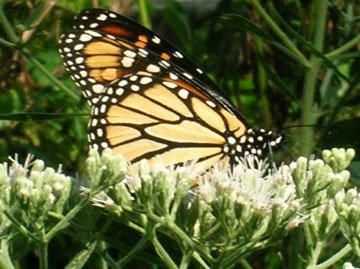
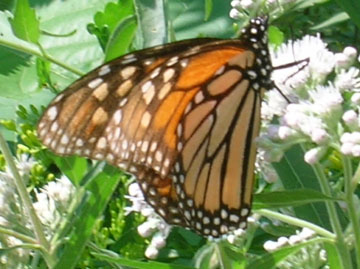
These monarchs were photographed in Lincoln Park in Chicago. They are on late boneset, a plant that is used heavily by migrating monarchs in northern Illinois.

Labels: , ,