Gossamer Tapestry

Reflections on conservation, butterflies, and ecology in the nation's heartland

Tuesday, August 17, 2010

Begin Year V

I can't believe that it's the anniversary of this blog again (well, it will be in about an hour), and that I've been at it for 4 years. To celebrate, I'm posting pictures of two beautiful beetles that I photographed in Arizona a couple of weeks ago.


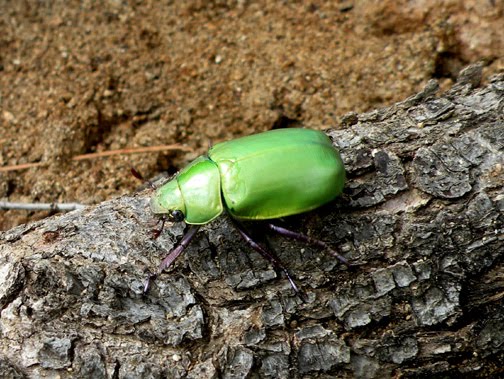
Chrysina gloriosa

Chrysina beyeri
You gotta love a beetle with purple legs

Both of these beetles were attracted to the lights around my cabin in Madera Canyon/ They were still on the tree when I got up the next morning.

Labels: , ,

Monday, August 09, 2010

What’s more difficult to see…

than a Trimerotropis latifasciata (broad-banded grasshopper) adult on lichen-encrusted clay exposures?

This question was recently posed by Ted at his blog Beetles in the Bush. Ever up for a challenge, I'd argue that a Leuronotina ritensis (Lichen Grasshopper) adult on a lichen-encrusted rock is a pretty good contender.


This species is narrowly endemic to the sky island mountains of southeast Arizona and adjacent Mexico. I photographed this individual in the Atascosas Mountains west of Nogales during my trip last week.

Labels: ,

Sunday, August 01, 2010

Hiking to Josephine Saddle with Andy


In my previous post, I mentioned having breakfast with Adam and Andy on my first morning in Tucson. I met them a year ago. Andy had found my blog through a comment that I had left on another Tucson blog- probably either Homer's or Cobban's. Adam and Andy do prairie restoration on the 400 acre farm in southwest Wisconsin that Andy's parents own. Leon and I have enjoyed getting to know them over the past year. Over breakfast, we discussed my plans for the coming week, and Andy expressed interest in joining me on one of my bug hunts. On Monday we drove down to Madera Canyon to hike up to Josephine saddle.


Milkweed

The day started cloudy, and the threat of rain was forecast. We were lucky, rain never materialized and the sun eventually came out. Because it was cloudy and we were hiking up a north-facing slope we did not see any insects at first. It's hard to get too disappointed about this- the scenery and botany are both amazing. Among the many interesting plants that we saw was a beautiful milkweed with maroon flowers.


View from the Trail

We ran into John, someone we had just met the day before while swimming with Homer. He had mentioned plans for a similar hike, but I hadn't expected to encounter his hiking party. Shortly after we ran into them, we began encountering more insects, including a bunch of butterflies.


Gold-costa Skipper (Cogia caicus)


Nabokov's Satyr (Cyllopsis pyracmon)


Marine Blue (Leptotes marina)

The saddle is an interesting destination, but still enough in the woods that there are not spectacular views there. We stopped for a snack of almonds and a few photos.


In Josephine Saddle with Andy

The trip back down was on a south-facing slope, which meant different plants and drier conditions. We saw lots of fat lizards along the trail. Much more interesting was the coral snake that we got a quick glimpse of.


On the Trail


We called this lizard Fatboy

Madera Canyon is famous for its three species of large, bright green scarab beetles. The are attracted to lights and very seldom seen during the day. Andy managed to find one, and I was delighted that he was able to experience that aspect of Madera Canyon. He posed with one on his hand to show how big they are.


Chrysina beyeri


Andy Poses with the Chrysina

As the hike wound down, my only disappointment was that we had not seen an Arizona Hairstreak, a species I wanted to photograph. We were nearly back to the parking lot before I saw one.


Arizona Hairstreak (Erora quaderna)

We wrapped up the hike and headed back up to Tucson to connect up with Adam for a fabulous dinner at a Guatemalan restaurant. It was a day of great scenery and insects and even better companionship.

Labels: , ,

Sunday, July 25, 2010

Another Adventure at Willcox Playa


Greetings from Tucson. I arrived Friday night. Saturday I headed on down to Willcox Playa, but not before a very pleasant breakfast with Adam and Andy at the B Line. The weather was interesting- a mix of clouds and sun. I dodged thunderstorms all the way out to Willcox. Although I spent much of the afternoon wondering if my time would be cut short by rain, it wasn't and the weather ended up helping the photography.


Aridlands Tiger Beetle (Ellipsoptera marutha)

I've never seen the playa so full of water. Numbers of tiger beetles were not overly impressive. As is often the case there, most of the individuals that I saw were the Aridlands Tiger Beetle (Ellipsoptera marutha). I've already got some reasonably good images, but I spent the first 45 minutes or so wandering around and snapping a few photos. As I have gained more experience with these beetles, I've come to realize that this is a pretty skittish species. The really gooshy mud that they like to land on also makes my typical technique- crawling on my belly to approach them- highly undesirable.


Aridlands Tiger Beetle (Ellipsoptera marutha)
Red Morph

I did get a look at one of the red color morphs of marutha. I've blogged about color variation in that species before, but I've never gotten a photo of the red form. I was pleased to be able to get close enough to shoot a couple of acceptable frames. Just as I was about to move on from that individual, a mating pair of green morph marutha darted out from under a clump of vegetation. Like a flash the red morph, obviously a male, pounced on the mating pair. For about the next five minutes, the trio of tigers lurched about as the red male tried to dislodge the green one. So intent were they on the struggle that I was able to approach very close to them for photography. In the end, the green male prevailed.


The struggle to breed:
Two male
Ellipsoptera marutha wrestle over a female

Shortly thereafter, clouds began covering the sun with a bit greater frequency. A beautiful Arizona monsoon thunderstorm was crossing the desert a couple of miles west of me. I quickly discovered that the softer light was extremely conducive to photography. The diminished glare rendered it easier to avoid harsh reflections from the metallic elytra of the beetles. The tiger beetles were easier to approach than they would be in full sun. I quickly got a pretty good shot of a Western Red-bellied Tiger Beetle (Cicindelidia sedecimpunctata).


Western Red-bellied Tiger Beetle (Cicindelidia sedecimpunctata)

As the clouds thickened a bit, a pretty green tiger beetle landed rather close to me. I was able to crouch down without scaring it. The mud in that area was not quite as wet and squishy as elsewhere on the playa, so I was able to try my technique of laying flat and inching my way closer to the beetle with my camera extended at arms length in front of me. The stars must have been aligned, because I was able to bring my camera within a foot of the beetle and get a nice series of photos. So intent was I on the approach and the composition of the pictures that I didn't even realize until got up to review them on my camera that my subject was not E. marutha.


Glittering Tiger Beetle (Habroscelimorpha fulgoris)

The Glittering Tiger Beetle (Habroscelimorpha fulgoris) lives in wet, salty mud in the arid Southwest. Subspecies erronea is found at Willcox Playa and nowhere else in the world. I had gotten the front of my tee shirt crusted with salty mud, but it was worth it.

I capped off my day cooling off in Cobban's pool with a glass of wine. This may have been my best visit ever to Willcox Playa.

Labels: , ,

Saturday, January 09, 2010

In which I pretend to be an archaeological entomologist


Shortly before Christmas, I was contacted by everyone's favorite gay archaeologist, Homer. He was working a dig in Tucson and had been uncovering artifacts from the 1890s. One of them was an old can that contained a bunch of dirt mixed with insects. If he sent me a sample, would I be willing to try to identify them? Ever up for a challenge, I said yes. A few days later, a vial of dirt mixed with insect parts arrived. I dug out some equipment and got to work.


Leg

The sample contained a bunch of fragments from what appeared to be a fairly large kind of beetle. From the size, color, and location, I had a pretty good idea right away what I was working with. The leg fragments (femora and tibiae only) were the first big clue. The tibia (straight, narrow section above) is about 6.5 mm long and the femur (the more oval secction) is about 7 mm long. They come from a pretty big bug. The metallic green coloring is distinctive. There were what looked like fragments of ribbon of the same color. These were sternites, the ridges of the abdominal segments.


Sternites

The sample also included a number of oddly shaped plate-like structures that were not metallic green. These were pronota. the pronotum is the dorsal covering of an insect's thorax.


Pronotum

By this point, I was pretty sure that I was working with parts of a biggish scarab beetle called a fig eater (Cotinis mutabilis) . They are bright green with a metallic luster below, and are green and brown with a matte luster above. I have several in my collection, including a couple collected right in Homer's back yard. When I compared the legs and pronota to those on my mounted specimens, they matched beautifully.


Cotinis mirabilis mutabilis
The pronotum is just towards the head from the pin


Cotinis mirabilis mutabilis showing the metallic green underside

Fig eaters range from Texas to California and south into Mexico. In the Tucson area they are a common species and fly from July to September during the summer monsoons. As their name implies, they eat fruit, especially if it's overripe or fermenting. I wonder if they had not entered the can to find fruit or fruit residues inside. Something was probably attracting them to the can, since I found so many remains. I recovered 18 pronota from the sample, which means that there were at least that many beetles in the can at one point.


Labels: , ,

Saturday, August 08, 2009

Arizona Before the Conference


Flame Skimmer (Libellula saturata) in Tanque Verde Canyon

I've been back from the annual Bug Conference in Arizona for nearly a week now. The trip was fun, and I'm just now feeling like life is getting back to normal. I wanted to concentrate a lot on my insect photography. Later I realized that I had done so almost to the exclusion of other photography. For example, on my first day in Arizona, Homer and I went down to Bisbee to visit Cobban and Ray. I took a couple of photos of a tiger beetle by their pool, but none of any of them nor of Cobban and Ray's beautiful house. Ah, well.


Filagree Skimmer (Pseudoleon superbus )


Mexican Amberwing (Perithemis intensa)

It has been unusually hot and dry this year, so the insects were not what they have been in previous years. The Sunday before last, I went out to Tanque Verde Canyon and photographed dragonflies. It was brutally hot, and I did not stay terribly long. I brought my usual amount of water, and it was inadequate for the extreme heat. I saw some cool species and collected a couple of interesting Buprestid beetles.


Willcox Playa

On Monday I went back to Willcox Playa to photograph tiger beetles. It was difficult for a variety of reasons. Due to the dry conditions, there were not that many beetles, and very poor species diversity. I had my new, better camera with me, and wanted to get better shots of both the Aridlands Tiger Beetle (Cicindela marutha) and the Black Sky Tiger Beetle (Cicindela nigrocoerulea). I succeeded from the standpoint that I now have better pictures of both of these species, but I'm still not entirely satisfied. There's always next year.


Aridlands Tiger Beetle (Cicindela marutha)


Black Sky Tiger Beetle (Cicindela nigrocoerulea)

On Tuesday of last week, I headed down to Rio Rico, but not before detouring west to Kitt Peak. I wanted to see and try to photograph gorgeous longhorn beetles in the genus Tragidion. I've seen them there before. Alas, the habitat where I had previously seen them had burned recently and was still looking pretty scorched.


Scorched vegetation at Kitt Peak

There was not a lot to see at Kitt Peak this year. I collected a couple of buprestid beetles (Agrilus pulchellus) at the roadside picnic area below the mountain. Part way up the mountain, I got another very pretty Agrilus, black with a bright metallic red head, on mesquite. There were some nice grasshoppers to photograph at the picnic area at the summit.


Slant-faced Grasshopper (Psoloessa texana) at the summit of Kitt Peak

So the insect viewing, photography, and collecting were not as good this year as they have been the past few times I have visited. Still, it was southeast Arizona during the monsoon season, and I can think of nowhere else I would have rather been.

Labels: , , ,

Monday, August 03, 2009

Zenna Henderson


Shortly after Leon and I began dating in the early 1980s, we discovered that we both shared an interest in science fiction. Leon was much better read than me, and introduced me to a number of new authors. One was a woman named Zenna Henderson. I began reading a compilation of several novellas called Pilgrimage.

One story in particular, called Pottage, really spoke to me. Like the rest of her stories, it involves the People, an alien race who were dispersed across the American Southwest when their spacecraft crashed there. They had strange powers, they could levitate and fly, and were despised and persecuted by the local populace because they were different. Pottage concerns one isolated community of the People who survived by suppressing and denying their true identity and not using any of their special powers. How could a story like that not resonate with a gay man just out of the closet?

In the early 1990s, this newfangled thing called the Internet was just coming to prominence. I once did a search on her name (no, I didn't Google it. If Google even existed at that time, I wasn't aware of it. I used Yahoo). There wasn't much information. She had lived in Arizona and had been a teacher. No surprises there- both of those aspects of her stories were obviously written from the inside. She was Mormon for part of her life. This background undoubtedly also influenced here themes of alienation. She was also deceased, for about a decade. I believe that she died of cancer, and did so prematurely as she was only in her mid sixties. The minimal information that was available online about her caused me to view her life as rather mysterious.


Nearly three years ago, I began this blog. In my profile, I list Zenna Henderson's People stories as an entry in the Favorite Books section. About a year and a half ago, I received an unexpected email.
I am an occasional reader of Cobban's blog (Lopaka Lounge), and this evening I happened to click on your name after reading your most recent comment. I was so excited to see that you're a fan of Zenna Henderson's works. She will always be Mrs. Henderson to me, as she was my first grade teacher.
I was floored- someone who had actually met her. We have had a small amount of correspondence, and it has been interesting to hear of what she was actually like as a teacher. Last year, just before I went to Arizona, my friend contacted me and suggested that I might look for her grave in St. David's cemetery just outside of Benson.

It was not to happen last year. This year, however, I drove with Homer down to Bisbee to visit with Cobban and his partner Ray. On the way home, we drove right past St. David's Cemetery. As Homer is an archaeologist and avid genealogist, he was happy to stop off and help me find her headstone. I'm very pleased to have been able to pay my respects to someone whose work I admire very much. Thanks, P. for contacting me and sharing your connection with her.


Photo by Homer

Labels: , , ,

Saturday, August 01, 2009

Magic Gas Stations

Doug has been a bad blogger. I've been busy with my travel, and out of contact with the Internet for long periods of time. I can do email and comment on blogs via iPhone, but I can't put up new blog posts that way. I'm still in Arizona, having a wonderful time at my conference.


I've been hitting the magic gas stations in southeastern Arizona this week, It's fun because there are so many more of them out this way than there are at home.


You want magic? I'll give you magic.

A magic gas station is one that is out in the middle of nowhere, or perhaps on the edge of town. It doesn't have to be a real gas station- a convenience store, motel, or any well lighted establishment that's in a location without a lot of competing light sources will do the trick. Magic gas stations function like very high wattage black or mercury vapor lights. They bring in lots of insects from a long distance and can be great collecting spots.


Wind Scorpion (Solfugidae) at the rest stop on Interstate 19

The magic gas station pictured at the top of this post is in Tubac, Arizona, just 15 or 20 miles north of the Mexican border. The first time that I went there I was actually gassing up my rental car and not specifically looking for insects. A huge longhorn beetle (Lochmaeocles marmorata) landed right on my car. There were no Lochmaeocles this year, but I got a nice series of a close relative called the Mesquite Girdler (Oncideres rhodosticta).


Mesquite Girdler (Oncideres rhodosticta)

Further north along Interstate 19, the Border Patrol checkpoint functions as a magic gas station. Still further north, the outside walls of the bathrooms at the rest area are also good collections spots. Thursday night, I saw a new (for me) species of tiger beetle there. The Sonoran Tiger Beetle (Cicindela wickhami) is one of many species of plants and animals that just barely make it into the US in extreme southeast Arizona from their broader ranges in Mexico.


Sonoran Tiger Beetle (Cicindela wickhami)

I've seen tiger beetles extraordinarily abundant at magic gas stations before. Several years ago I was at a Chevron station in Sunsites, Arizona. The pumps were covered with hundreds of tiny pink White-lined Tiger Beetles (Cicindela lemniscata) interspersed with dozens of much larger green Cicindela punctulata chihuahuae. A spectacular sight, indeed.


White-lined Tiger Beetle (Cicindela lemniscata)


Cicindela punctulata chihuahuae

Labels: , , ,

Monday, June 29, 2009

Meeting Cobban and Ray


L-R: Cobban, Doug, Ray

I had wanted to post this earlier, but left my camera at work over the weekend. On Friday, I met another blogging friend and his partner. Cobban writes the Lopaka Lounge blog. He and Ray live between Bisbee and Sierra Vista, Arizona, one of my favorite places on the planet. Cobban and I have been corresponding for about a year and a half. He and Ray are great guys. It was fun showing them around the museum. We went for lunch at North Pond afterwards. We're going to try to get together when I'm out in southeast Arizona in a few weeks.

Labels: , , ,

Monday, August 11, 2008

The Lichen Grasshopper


Leuronotina ritensis - The Lichen Grasshopper

Two years ago, as a brand new blogger, I posted about the Invertebrates in Captivity Conference. In it, I mentioned that I had an adventure in the Santa Rita Mountains during an unsuccessful quest for an endemic grasshopper. Although I did not find the grasshopper, I did have an unexpected encounter with a bear (and not in a good way). Each of us startled the other. I began yelling and throwing rocks at the bear while trying to look bigger than I am by waving my butterfly net over my head. The bear was looking very puzzled about this bizarre human behavior, and climbed a tree to further ponder the strangeness of the situation. I took advantage and did not run away, but walked purposefully down the trail.

Last year, I wanted to go back (this time with a companion for safety) to try to find the grasshopper. It poured buckets in a monsoon thunderstorm that day. I really wanted to see this grashopper, in part because they have very exacting requirements. They live on bare rock that is covered with lichens, on which they are well camouflaged.

This year, I returned yet again. Although we had a fine day, the lichen grasshopper did not show up. I left vowing to try again next year. Imagine my surprise when I later found a population in a completely different mountain range.


Leuronotina ritensis habitat in the Atascosas Mountains.
The grasshoppers were on the bare patch of rock that is visible in the center of the photo.


Leuronotina ritensis is described in Otte's The North American Grasshoppers as "[p]resently known only from between 5,000 and 8,000 feet on the Santa Rita Mountains in southern Arizona and from Sierra de los Ajos, at the head of Canyon de Evans, Sonora, Mexico." The book was published nearly 25 years ago, and I have no idea how many other locations it has turned up in in the intervening years. Still, when I find something outside of a reported range from a group that I do not have personal expertise in, I'm reluctant to make the call on my own.

What to do? Easy. Post my photo to BugGuide.net and wait for noted grasshopper expert David Ferguson to weigh in on the matter. David expressed a lack of surprise that it would turn up where it did.

So where did I find my lichen grasshopper? Right off of Ruby Road between Peña Blanca Lake and Sycamore Canyon. As I wrote in my initial post at BugGuide:

These have beautiful dark orange hindwings. They perched on bare, lichen-coverd rocks, on which they are well camouflaged. They were reluctant to move when disturbed. Their habitat and appearance remind me of descriptions of Leuronotina ritensis...


A mounted specimen of Leuronotina ritensis showing the dark orange hindwings

David confirmed that they indeed were Leuronotina ritensis and said that he expected that these would turn up on some of the other mountain "sky islands" of southeast Arizona. He is no doubt correct. They may well have already been reported from the Atascosas where I took mine. The exact spot where I got them was not 100 yards from the road. They probably aren't particularly rare. Still, the opportunity to observe something endemic to a part of the world that I truly love is always special. The fact that I've been looking for 2 years just made finding it that much sweeter.

Labels: , ,