Gossamer Tapestry

Reflections on conservation, butterflies, and ecology in the nation's heartland

Sunday, November 15, 2009

Journey to the Cameron Highlands

The hosting institution for the ICBES conference in Malaysia was Tropical Entomological House. They maintain a beautiful butterfly display in Penang and supply live butterflies to other butterfly displays around the world, including ours. Earlier in the week , we had visited both their public display and their breeding facility. It looked lovely, even in the rain. Our hosts were, nonetheless, a bit disappointed that they had not able to show their facility at it's best due to the weather. They wanted us to return. As someone who runs a similar exhibit, I fully understood the motivation. Saturday morning was beautifully sunny, so we delayed our departure for the post-conference tour of the Cameron Highlands in order to have a better look at the exhibit.

I enjoyed the exhibit for a bit while waiting for my friend BT to show up. I had an ulterior motive. There is a nice population of tiger beetles on the grounds of the Butterfly Farm, and BT had told me I could collect a series. Let's just say that I had a very good time.


Spotted Tiger Beetle (Cicindela aurulenta)

This was the only species of tiger beetle that I would see on the trip, however I got to see it in several different locations. We departed the Farm for a journey to the mainland peninsula of Malaysia, with the plan of seeing some sites on the way to the Cameron Highlands. Penang is an island, and we departed via the longest bridge in Southeast Asia. It was a glorious day and we were treated to views of the islands dotting the Strait of Penang.


Island in the Strait of Penang

The road runs through an extensive region of oil palm plantations, then enters some beautiful tropical forest near the mountains. We skirted the coast and had lunch at a fishing village. The restaurant where we ate is the upstairs of a facility where fish is unloaded from the boats. Let's just say that the fish was very fresh. I especially enjoyed the pompano and the blood cockles.


Fishing docks viewed from the restaurant


Fisherman about to catch a line and tie his boat up

The fishing village was on a river estuary, surrounded by mangrove forests. There is a beautiful nature reserve with boardwalks though the mangroves. We visited after lunch. There was excellent wildlife viewing, including long-tailed macaques.


Mangrove Forest


Colorful Crab


Hairstreak
It's disconcerting to be as unfamiliar with the butterflies as I was here.


Long-tailed Macaque (Macaca fascicularis)

During the walk through the mangroves, I had a chat with Michael who was part of the hosting team. On the first day of the conference, as I was signing in, he approached me. Asking if I was Doug Taron, he told me that he was a reader of Gossamer Tapestry. Hi, Michael! As I was taking photographs, he asked if I planned to blog about this. I said or course, and had a colleague take a picture of the two of us so i could post it here.


Michael, Mangroves, and Me

While the mangroves forest seems idyllic, it is exploited as a resource. After lunch we stopped by a charcoal factory that used mangrove wood as a raw material. We were told that the mangrove is sustainably harvested. I have no way of assessing this myself. The boardwalk runs through secondary forest, the primary forest having long ago been cleared for charcoal. The charcoal factory was decidedly low tech, using human labor rather than machinery for most of the operation.


A worker shovels finished charcoal out of a kiln

By now it was late afternoon. It would take us several hours more to travel into the mountains where we would spend the next day. It was dark when we arrived and I fell asleep to the gentle tapping of tropical rain on the window.

Labels: , , , ,

Tuesday, July 14, 2009

Butterfly Restoration in Oak Openings


Kitty Todd Preserve outside of Toledo, Ohio

The Imperiled Butterfly Conservation and Management Workshop has been going very well. Our attendees come from all over the US and Canada, and have a variety of backgrounds and interests. We're hearing a lot about the research activities of the Toledo Zoo, the institution hosting this segment of the workshop. They are working with two endangered species: the Karner Blue and Mitchell's Satyr. Today we visited a number of Karner Blue release sites, and even got to release some butterflies.


Me releasing a Karner


Recently released Karner Blue
Note the red marking dot that identifies this as a lab-raised butterfly

Kitty Todd is part of the oak openings ecosystem. It's similar to the dune and swale ecosystem of northwest Indiana, and has a similar geological history. Both ecosystems are home to Karner blues, however the vegetation is very different. Many unusual plants and animals can be found here.


We saw acres of this milkwort (Polygala sp.)


Edwards Hairstreak (Satyrium edwardsi), a species of special concern in Ohio,
is found in Oak Openings Park near Kitty Todd


Cicindela lepida habitat

One of the sites that we visited today, Oak Openings Park, still contains an active sand dune, even though it's miles from Lake Erie. I immediately thought of tiger beetles when I was it, and wasn't disappointed. The Ghost Tiger Beetle (Cicindela lepida) is a new species to me. I got photos, but I was happier with them on my camera screen that I was when I got them moved onto my computer. Still, a very nice beetle.


Ghost Tiger Beetle (Cicindela lepida)

After lunch, the group participated in more Karner Blue releases. So far, it has been an interesting and enjoyable workshop. I feel like I'm making contributions to the teaching part of this (I'm definitely holding my own on plant identification), I'm seeing new things and I'm making some great new connections.


Brian and Steve release a Karner

Tomorrow, we head up to Michigan. With luck, I'll get my first ever look at an endangered species caled Mitchell's Satyr. I can't wait.


This female Karner Blue was not raised in the laboratory

Labels: , , , , ,

Thursday, July 02, 2009

Finding Something New in a Place I Know Well


My trip to New England was several weeks ago- but I wanted to do a final post about my last day there before I forgot about it. Before going boating, Leon and I took a quick hike up to Agassiz Rock to try to see the rare red-bellied tiger beetles. No luck, but I did take GPS coordinates and some better habitat photos.


The tiger beetles run over the open expanses of bare granite. I think we may have been a bit too early to see them- the Massachusetts data sheet that I have lists flight times in July and August.


Northern Cloudywing (Thorybes pylades) along the carriage road

That evening, we planned on taking my dad out for an early Father's Day dinner. We got back from boating with plenty of time to spare, and decided to go for a walk in the woods before dressing for dinner. There are old carriage roads all over the woods next to Dad's house, and I wanted to walk there and do some insect photography.


Spangled Skimmer (Libellula cyanea)

Way down one of the carriage roads, we saw an unfamiliar side trail into the woods. We decided to follow it for a while. I vaguely remembered it leading to a pond. It did- but not the pond I remembered. I was absolutely stunned to break out of the woods and find an absolutely gorgeous floating sphagnum bog.


Floating bogs form where sphagnum moss begins growing around the periphery of a pond. The moss forms a floating mat that thickens and begins growing towards the center of the pond. Eventually other plants, including shrubs and small trees, begin growing in the floating mat. Many floating bogs, including this one, retain open water at the center. They can be treacherous to walk on- it's possible to break through the floating mat and become trapped under it.


Sundew! (Drosera rotundifolia)

Sphagnum bogs are home to an amazing array of specialized plants, including orchids and carniverous plants like this sundew. We weren't dressed for slogging our way out into the soggy center (boots, or even hip waders are needed for that sort of thing), so we had to be content with looking in from the edges. I would have loved to have known this was there when I was growing up. I'll definitely have to go back. We were too early in the season to see if the rare bog copper butterfly can be found in this bog.

Labels: , , , , , ,

Saturday, May 30, 2009

Dune and Swale


In Northwest Indiana, at the southern tip of Lake Michigan, you can find a remarkable ecosystem. Over the last 10,000-20,000 years, the Lake Michigan shoreline has been gradually receding. As the lake recedes, the sand dunes become stabilized by a shifting sequence of vegetative changes known as primary succession. What begins as a sandy community of grasses becomes a wooded ecosystem. The dune ridges remain as gently hills running parallel to the lakeshore. The swales between them remain wet, at least during parts of the year. The dunes and swales are home to a remarkable community of plants and animals.

Today Leon and I visited with John and Jane, longtime friends from the prairie restoration movement; Laurel, a longtime friend from prairie restoration who now works at the Field Museum. Our guide was Paul from the Indiana field office of The Nature Conservancy and steward of the two sites that we toured.


Robin's Plantain (Erigeron pulcehllus) on a wooded dune


Wild Lupine (Lupinus perennis) and Prairie Phlox (Phlox pilosa)

We had come in search of two species: The endangered Karner Blue butterfly, and Yellow Ladyslipper orchids. It was cloudy, and even sprinkled a bit as we arrived. But the plant viewing was so amazing that we didn't mind. Besides, the weather forecast was for clearing around lunchtime.


Yellow Ladyslipper (Cypripedium calceolus)

It didn't take us long to find our first ladyslippers. This is an amazing orchid. It's reasonably large (the pouches are over an inch long. Although a rare plant globally, it's extremely common in the dune and swale ecosystems in Indiana. We saw thousands of blooming plants during our travels today. Some were individaul sprigs. Others small clumps.


A clump of ladyslippers

At times, there were large patches with hundreds of blooms in them.


Part of a huge patch of orchids

As we walked further, we had to traverse numerous swales. It was a day of wet feet (and ticks...but let's not dwell on unpleasantries here).


One of the swales where we got our feet wet


Blue Flag Iris (Iris versicolor)

At last, it the skies began to lighten. No butterfiles initially, but we did start seeing some other insects.


A bird dropping moth in the family Noctuidae

A net-winged beetle (Calopteron reticulatum)

Finally the sun broke through. Would be see Karners? Yes we would- almost immediately once the sun broke out.


Male Karner Blue (Lyciades melissa samuelis) basking

Karener Blue caterpillars feed on leaves of the lupines that are so abundant in the dune and swale ecosystems. It has vanished from over 90% of its range and was declared an endangered species by the fedreal government in 1992.


Male Karner Blue, underside
This one embiggens well

Such satisfaction. Endnagered butterflies. Rare orchids. Other fabulous plants and animals. What more could we possibly have wanted? I was thrilled. I would have gone home happy. I got to get another good look at another very rare butterfly.


Dusted Skipper (Atrytonopsis hianna)

The Dusted Skipper is a very rare species that lives in sandy areas. I am aware of only two populations in Illinois. They are a bit more abundant in northwest Indiana, but still a rare species. These posed for photos.


This was definitely a day to savor. I spent time with friends that I don't see often enough. We visited beautiful, rich and rare habitats and saw and photographed lots of rare plants and animals. Our day ended with pleasant conversation at a nearby Mexican restaurant.

Labels: , , , , ,

Saturday, May 23, 2009

Tiger Hunting in Chicago


Montrose Point in Chicago is an unexpected location. It sits at the south end of one of the major city beaches on Lake Michigan. The point extends into the lake, making it a migrant trap for birds. Such a diversity of migrating bird life has been encountered here that it has been nicknamed The Magic Hedge.

Some years ago, sprigs of native (and very rare) dune grass began appearing in the sand along the lake. A bit of protection from trampling was offered, and grass began expanding into patches that allowed the wind to re-sculpt the sand dunes that would have originally been found here. Almost by magic, other dune plant species began appearing. Eventually, a stewardship team assembled and began active restoration and management of the site. They have added some appropriate plant species, however most of the biological diversity has returned on its own.


What have returned on their own are tiger beetles. They have returned in huge numbers. I went out last Thursday to do a survey. I only found one species, the bronzed tiger beetle (Cicindela repandra), however this species is present in almost staggering numbers. There are thousands, perhaps tens of thousands of individuals on just a couple of acres of land. Despite their abundance and accessibility, they are very wary and difficult to photograph. I did manage to get off a couple of decent shots.


I'm thrilled and amazed that I can find tigers in such an urbanized setting.

Labels: , ,

Monday, October 16, 2006

Gladstone Fen


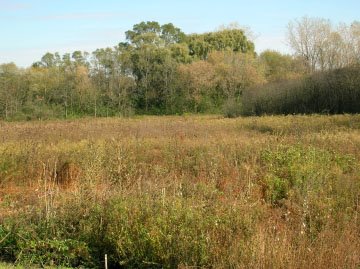
Gladstone Fen

The first time that I was ever in the tropics was on a trip to Peru in 1986. It was an awesome trip, and I’ll probably post a remembrance of it sometime. My fellow travelers were a really interesting bunch of people, and I have maintained friendships with some of them. A year after the trip, I was sitting next to fellow travelers Lee Gladstone and his wife Gertrude at a trip reunion dinner. Lee knew that I was a biologist, but did not know of my work at Bluff Spring Fen. During the meal, he turned to me and asked what I know of fens. Now this is not a typical topic of dinner conversation, and I was a bit nonplussed that he would ask this. It turned out that he had just learned that he had one in the back yard of his weekend house in McHenry County. I wanted to see it, and a few weeks later they had me out.


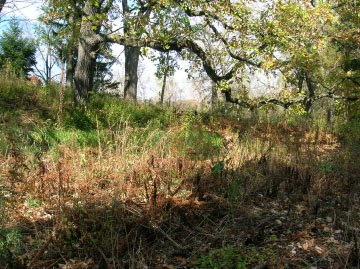
Oak woodland at Gladstone Fen

People frequently tell me that they own property with a rare ecosystem on it. Generally the ecosystem disappoints, but Lee and Gertrude’s place was the real deal. Their back yard contained about 6 acres of really nice fen. It was suffering from a lot of the degradation that fens in Illinois do- fire suppression, invasion by nonnative species, hydrology issues. Still, there was a relatively intact ecosystem and a surprising number of rare plant species. Eventually, I would also find a bunch of rare butterflies there, as well.


View from the oak woodland into Gladstone Fen

Over the next decade, I would be the steward of this site. Lee and Gertrude used to have a bunch of friends from the city out to their weekend place. Leon and I would give interpretive tours of the fen, and then we’d all troop inside for a fabulous lunch. We held a bunch of workdays involving brush clearing and seed planting. We had several fine burns at the fen. Eventually the site was formally dedicated as an Illinois Nature Preserve. The site flourished under management. Since the late 1990s, I have been less able to participate in active management there.

This weekend Lee and Gertrude’s daughter Lorna invited us up for a special workday. We were joined by about a dozen other people, many of whom I know because they are active in the conservation community up in McHenry County. We were clearing out buckthorn, a very aggressive non-native tree that damages oak woodlands. We lit a bonfire and tossed the sapling trees onto it as they were cut down with chainsaws. It was satisfying work, and we made some great progress. Since her parent’s deaths, about a year apart and nearly five years ago, Lorna has taken up the mantle as site steward and is really doing a fine job.


The bonfire

After the workday and the bonfires, we all went on back to the house and had a great lunch. I had been back to the site once since Lee and Gertrude had died, but this was my first time back in their house. I’ll confess that it put a lump in my throat. It was a different cast of characters, but the feeling was very similar. I had worried about what would happen to Gladstone Fen after Lee and Gertrude died (they were in their seventies when I met them), and I’m pleased to see it in such good hands.


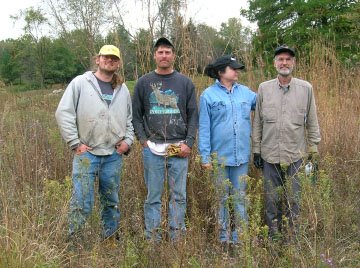
Part of yesterday's work crew. L-R: Will, John, Lorna, Leon

One afternoon about a year after Gertrude had passed on, I was walking through the Museum where I work and happened upon Lee sitting on a bench in one of the exhibits. Lee’s city home was just a few blocks from the Museum. He and his home care nurse had gone for a walk because it was a nice day, and had stopped in. I had no meetings or deadlines that afternoon, and got to spend about a half an hour chatting with him. He seemed much more subdued than usual. One of the things that I had always liked about Lee was his vibrancy as a person, and I remember feeling that his wife’s death had affected him very deeply. I will always treasure that particular conversation, because just three weeks later I would learn of Lee’s death.

Labels: , , ,

Monday, September 25, 2006

My Favorite Ecosystems

Last Week, I posted a "top 10" list. Since then, I've been thinking about doing another one that was a bit more specific to this blog. Here is a list of my top 10 favorite ecosystems in the world. I have actually visited all of these, except one, as will become apparent.

1. Tallgrass Prairie


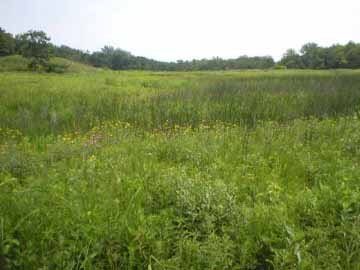
Bluff Spring Fen

Any list of my favorite ecosystems would have to start with this one, if only because I have now spent over half of my life studying, managing, and restoring examples of this ecosystem.

2. Sonoran Desert Scrub


Below Kitt Peak, Arizona


The first time I visited the Sonoran Desert was spring of 1988. I went for a hike in the west unit of Saguaro National Park (then still Saguaro National Monument). The spring flowers were in full bloom, but what struck me most was the larger vegetation. Saguaro cactus is really playing the role of a tree in this ecosystem. There are other trees, too- vase shaped ocotillos, gnarly desert hackberries, spiny mesquite trees, twiggy palo verdes. I began thinking of the place as the enchanted forest. It’s a desert. Yet in its own way it’s also a forest- but the trees all look somehow like they should be growing on the bottom of the ocean. It’s now nearly 20 years later, and I still feel the same sense of enchantment every time I visit.

3. Bermuda Cedar Forest


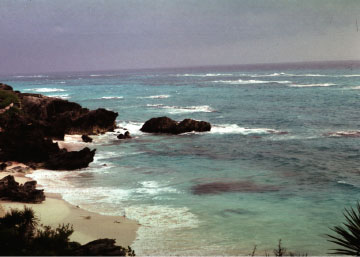
Top: Bermuda Coast Bottom: Remnant Cedar Forest


Sadly, some of my favorite ecosystems have virtually vanished from the planet. The island of Bermuda was once clothed with a dense forest dominated by Bermuda Cedar, a native palmetto, and Bermuda Olivewood. All of these trees are endemic to Bermuda, that is, they grow naturally nowhere else in the world. All three are now threatened with extinction. As with so many islands, the native ecosystem of Bermuda has been ravaged by development and the changes brought about by the introduction of non-native species to the islands. Ecologist David Wingate has done a masterful job of restoring an example of this ecosystem on Nonesuch Island, a tiny islet off shore from the main island. In addition, Wingate has been instrumental in bringing a bird called the Bermuda Petrel, or Cahow, back from the brink of extinction. Wingate estimates that for 200 years prior to recovery activities focused on the Cahow, there were never more than 15 breeding pairs alive at any time. The survival of the species along such a tenuous thread of existence is the stuff of near miracles.

4. Puna


At 15,000' below Salkantay, Peru


This is the one that you are least likely to guess where or what it is from the name of the ecosystem. Puna is a high elevation grass and scrubland found in Peru and adjoining countries. In 1989, my partner and I spent a week backpacking in the Cordillera Vilcabamba north of Cuzco. It’s always a bit disorienting for me when I do something like this, as I’m used to being familiar with a good fraction of the plant species that I’m seeing while out and about. Our travels took us past tropical mountain glaciers, over a 16,000 ft mountain pass, and through scenery as beautiful as anything I’ve ever encountered elsewhere. One valley that we descended into was home to plants that were close relatives of familiar prairie plants growing there. It felt sort of like home except that dotted among the tick trefoils and geums were beautiful yellow oncidium orchids in full bloom.

5. Fan Palm Oasis


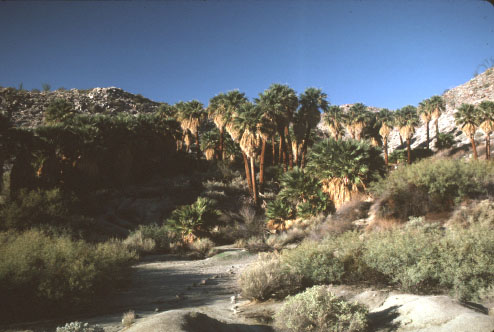
Southwest Grove, Anza Borrego State Park


In the deserts of southern California, there are places where faulting forces groundwater up to the surface. Here the only species of palm tree native to the western United States takes hold. Its amazing to sit in the shade of the palm trees looking out at the harsh desert light outside of the oasis. The air is much cooler, there is lots of bird activity up in the palm fronds, and the entire oasis buzzes. The sound is from hundreds of bees collecting water from the damp mud at the edge of the pools that are found in many of the palm groves.

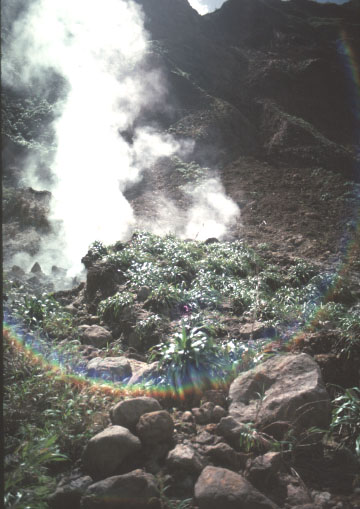
6. Windward Islands Rain Forest


Top: Dominica Bottom: Vegetation around fumerole


The windward islands form the boundary between the Caribbean Sea and Atlantic Ocean. They are steep sided volcanic mountains. Dominca is the most unspoiled of the lot and covered with dense rain forest. At higher elevations there are fumeroles, hot springs, and even a boiling lake. Two rare species of endemic parrots fly in the rain forests. In one area, there is a ravine about 30 feet deep and about three feet wide. Dominica offers a glimpse of what the islands of the region looked like before Columbus.

7. Florida Pine Rocklands


Big Pine Key


The Florida rocklands are an ecosystem that I have come to know only recently. It is now confined to portions of the Everglades, and to Big and Little Pine Keys about three quarters of the way from Miami to Key West. The soil is very thin over a layer of fossilized coral reef that pokes through the soil here and there. There are sinkholes scattered about where rare ferns and orchids can sometimes be found. There is a strong Caribbean influence to the vegetation. The rocklands of the Everglades are always enjoyable to visit because we encounter coontie, a native Floridian species of cycad that is the host plant of a rare butterfly called the Atala. Cycads are a passion of my partner’s so we both enjoy finding them. Contributing to my enjoyment of this ecosystem is the fact that we usually visit on our annual vacation to the Florida Keys, where we get to spend time with some good friends. This year instead of going to the Keys we will visit Costa Rica, where we will encounter:

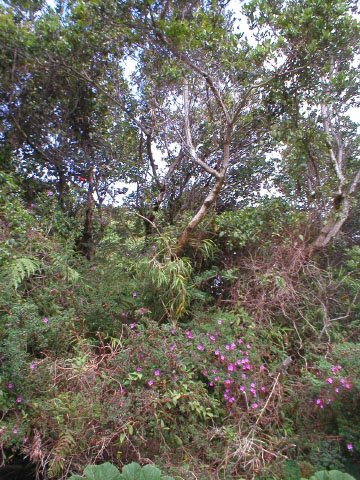
8. Central American Cloud Forest


Volcán Poas, Costa Rica


This is a high elevation tropical forest. It’s typical of some of the Central American volcanoes. I am most familiar with it from Poas Volcano in Costa Rica. Many people will be surprised that I have chosen a butterfly-poor habitat as one of my favorite tropical ecosystems, but it’s a beautiful one. The forest is somewhat stunted and twisted by the mountain winds. The branches of the trees are covered with a denser growth of epiphytic orchids, ferns, and bromeliads than I have seen anyplace else in the world. It’s often misty, as one is engulfed in the clouds that give this ecosystem its name, and this contributes to the relatively poor abundance of butterflies. But there are hummingbirds everywhere, and it’s a real treat to see them flitting among the bromeliads, taking nectar from the bright red flower spikes.

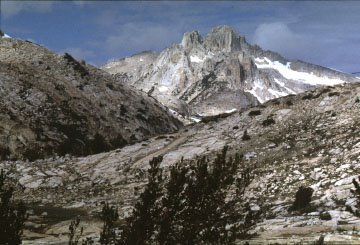
9. Sierra Nevada Alpine Zone


Top: The High Sierra Bottom: Behr's Sulphur


This is another sparse and austere ecosystem. The dominant feature is very white granite everywhere, but there’s lots of life, too. In the zone ranging from near to above treeline, beautiful alpine meadows grow interspersed with groves of stunted conifers. The meadows are often filled with dozens of species of colorful wildflowers, including lupines, gentians and monkey flowers. Despite the harsh climate, this is an area rich in butterflies. One of my favorites is Behr’s sulphur. It lives in the high California Sierras and nowhere else in the world. It’s a member of the large genus Colias, which includes many of the little yellow butterflies common throughout temperate regions. Behr’s sulphur is the only member of the genus that is predominantly green.

10. Hydrothermal Sea Vent


Black Smoker and Giant Tube Worms


This is the coolest ecosystem that I will never have the opportunity to visit. Vent communities are located in the perpetual darkness of the ocean floor, in geologically active regions. Underwater geysers called black (or white) smokers spew ferociously hot water filled with compounds in a reduced chemical state. Not the sort of things that we commonly consider to be nutrients, the power the bacteria that form the base of the food chain here. Unlike more familiar ecosystems, these nutrients enter the food chain from the Earth’s mantle, rather than from the sun via photosynthesis. Organisms that live here must cope with the extreme pressures of the ocean depths, total darkness, and temperatures that can range from above the boiling point of water (the pressure keeps it liquid) to icy cold. Despite these challenges, far from being species-poor, these are very rich ecosystems. Their inhabitants can include crabs, clams, mussels, giant tubeworms that can be over six feet ling and have no mouths, and even fish. Because of their great remoteness in the ocean depths, these communities remained unknown until the 1970s.
Labels: