Gossamer Tapestry

Reflections on conservation, butterflies, and ecology in the nation's heartland

Tuesday, December 04, 2007

Watch out for that....Tree


The last morning of my time in Mindo there were outside activities planned. I opted for the jungle hike and zipline trip. It was my best jungle experience of the trip.

The hike followed the sendero between the ridgetop lodge and the river. I had been partway down the trail a couple of times already and new that it crossed some pretty nice secondary forest. There were lots of butterflies, especially a group of brown butterflies known as satyrids.


Satyrid butterflies courting


Pedaliodes peucestas, a huge South American genus of Satyrids
with dozens of confusingly similar species

Descending lower into the forest, the canopy became more dense. Beautiful clearwing butterflies were fairly frequent. At one point, we passed a branch that had fallen from the canopy. An epiphytic orchid in full bloom was thus brought into view. We passed several orchid species. At one point the trail crossed a small stream where a helicopter damselfly had set up territory.


A clearwing butterfly

Tropical orchid (Catteleya?) on a fallen branch
A bit of canopy visible on the jungle floor


Polythore gigantea

Further down the trail, somebody had placed a dam across a small stream creating a jungle pool. Pretty, but clearly artificial. The only thing that I saw in the pool were a couple of goldfish. We did se lots of leaf beetles on this part of the trip. They included some of the most specitaular beetles that I saw on the entire trip- with the exception of the giant dynastine beetle on rotten fruit at the beginning of the sendero.


The jungle pool


Leaf beetle


More leaf beetle (Platyphora)


Still more leaf beetle (Aspicela bourcieri)


Dynastine (Rhinoceros) beetle on banana

The trail passed a rope swing that someone had set up. The entire party took turns playing George of the Jungle. Mucho fun. Most of the party continues on to the zip lines. A few of us hung back, however. Nancy, Caspar, Laurie, Eddie and I took a detour on our own and waited 45 minutes for the rest of the party to return. It was a welcome diversion. The smaller group meant that we could see a lot more stuff. We had two genuine botanists in this group- Nancy is even a tropical botanist. We spent our time botanizing and insect watching. I learned a lot, including useful information like the identity of nature’s toilet paper. I can now proceed much more fearlessly on jungle forays.


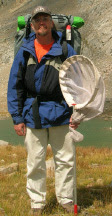
Doug of the Jungle


A hawkmoth. The gorgeous hot-pink hindwings are just barely visible in this photo. 
(Adhemarius sexoculata)


Don't touch! This tussock moth larva has urticating (stinging) hairs


Even the leafhoppers were pretty on this walk


A metallic blue staphylinid beetle

Later, back at Rio Mindo, we saw a bunch more beautiful tropical butterflies. It was a great trip. Someday I’ll return to Mindo.


Daggerwing butterfly (Marpesia corinna)


Quick, what's the square root of 7921? Diaethria neglecta has the answer.

Labels: , , , ,

Sunday, November 25, 2007

Nocturne


Rio Mindo

My first evening in Midno, Ecuador. Qindeopugo, the lodge where I am staying, backs up onto the Rio Mindo. The daylight is beginning to fail, and the entire cloud forest is taking on the blue cast of twilight. The night sounds are beginning, and the persistent rush of the river is blending into a din of frog cronking and katydid whirring. The frogs’ calls are a constant and varied backdrop to the night sounds. There is lots of species diversity. Some of the loudest calls come from remarkably tiny frogs.

Up the hill, a pootoo’s eerie call can be heard. It sounds like a cross between a whippoorwill, to which it’s related, and an owl. A real owl silently swoops out of the forest and lands on the sign in front of the lodge. This turns out to be his regular territory- but I never manage to get a photo despite repeated visits of said owl to said spot.


Tiny tree snail

Way up at the top of the valley black lighting is beginning. We are too far away to hear the muffled hum of the generator as Mark, Martin, and Wayne set the lights up. I have an invitation to attend, but the half-hour’s van ride each way dissuades me. Instead I decide to go for a night walk up the dirt road. I’m with Nancy, Laurie and Eddie from the Houston Museum of Natural History’s butterfly exhibit, and Lea from the Museum of Science in Boston.

We turn on our headlamps and head out into the gloaming. Playing our lights over the vegetation, we find the tinier creatures of the cloud forest scattered here and there in the grasses. Four groups seem especially well represented: walking sticks, katydids, leaf beetles and spiders. I’m especially interested in the leaf, or chrysomelid, beetles. I think of my friend John from Denver who is a chrysomelid expert. He is also the person turned me on to beetles, a group that I had minimal interest in before he began teaching me about them. John used to work with the Houston folks. His name comes up frequently. We all agree that he would love to be part of this trip. Alas, he remains in Denver this time.


A leaf beetle by night (Asphaera nobilitata)


Another leaf beetle. This one's in the genus Zygogramma.
Edit:  Calligrapha fulvipes

We walk very slowly up the road. The night sounds are punctuated by occasional human voices. "Got another walking stick over here." "Hey, this katydid’s shedding." "What is that spider eating?" Ahead of us, the Southern Cross twinkles on the horizon, while behind us a distant thunderstorm silently flickers on the hillsides. I will pass this way tomorrow on my morning run and discover that we have taken over an hour to wander 100 yards.


We saw a lot of walking sticks on our night hike.


What's that spider harvestman eating? Mr. Cricket comes to dinner.


Predator becomes victim. This spider was atacked by a fungus.


Polka dots are part of this season's line of evening wear.
Agriacris magnifica

Back at camp, still more insects have come to the light around the lodge. My room is a tiny space under the eves- I can barely stand up right next to the wall. I have left the light on, and the skylight at my right shoulder is covered with moths and beetles- my own private blacklighting event. I fall asleep to the gentle patter of insect bodies pelting the skylight even after I turn off the light. I am truly in my element. I am in the tropics.


Back at the lodge, an Automeris moth has come to the lights.
My katydid is bigger than your katydid.

Labels: , , ,

Tuesday, November 20, 2007

Festival of Moths - Blacklighting Adventures in Mindo, Ecuador


The setup. You can see one mercury vapor light behind the sheet and another at the left hand side. Behind and towards the left hand edge of the sheet is a fluorescent black light tube.

I am a recent convert to black lighting, and I’ve been craving a real tropical experience with it. Black lighting is a process for attracting nocturnal insects for observation, collecting, or photography. A sheet is suspended so that it hangs down with the lower edge draping onto the ground. Fluorescent black lights or mercury vapor lights are then placed in front of the sheet. Night-flying insects are drawn in and land on the sheet or on the nearby ground. I had a go of it in Costa Rica last winter. Unfortunately, February on the Costa Rican Pacific coast is a very dry time of year, and I attracted little.

My Ecuadorian experience was much more rewarding. A couple of the guys attending the conference are going on to the Amazon afterwards and brought black lighting equipment with them. They borrowed a gasoline-powered generator from our host in Ecuador, and good times ensued.

They set up on two consecutive nights. The first was on a ridge line at about 5,000’ above the town of Mindo. The other was along the Mindo River about 1000’ lower. The habitat in both cases is cloud forest. We got substantially different stuff at both locations. I offer the following festival of moth photos as a small sampling of what we saw.

Night 1: Black Lighting at Sachatamia Lodge. November 14, 2007.


Satyrniidae. This species had about an 8" wingspan.
Added 3/12:
Rhescyntis hippodamia


Automeris sp.


The moth with headlights. The bright white spots are not luminescent like a firefly, but they did glow brilliantly under the black light. Could the scales contain a fluorescent compound? Edited 7/20/16 Dysschema marginalis


A tiger moth that mimics clearwing butterflies. The wings were completely transparent. Clearwing butterflies are toxic (the larvae eat nightshades). I don't know whether the moth is also toxic (Müllerian mimicry) or tasty (Batesian mimicry). Hyalurga urioides


This moth confused me. It's a dead ringer for certain kinds of metalmark butterfly, but it's clearly a moth. Some sort of mimicry?
(Edited 7/14  Erateina sp.)


Since we're going on about mimicry, I thought I''d include one photo of a leaf mimic. There were many species of moths on the sheet that looked like leaves.


There were several species of beautiful red moths. I'm pretty sure that most of them were tiger moths (Edited 7/14 
Hyperthaema orbicularis).


Another beautiful red and black moth.


A study in 8's
(Edited 7/14 Pantherodes unciaria- a Geometrid)


This moth was tiny. The wingspan was only about 1/2".


Nope, it's not photoshopped. Those really are the colors. I love the tropics.
Heterochroma viridipicta


Blacklighting along Rio Mindo. November 15, 2007. There was much more at the sheet along the river. Unfortunately, the generator ran out of gas fairly early in the evening, so the festivities were cut short.


I'm pretty sure this is in the family Uraniidae (Nope. Sematuridae). Many species in this family are diurnal and look like swallowtail butterflies. This one came to lights.  Homidiana canace


Unfortunately, you can only get a glimpse of the beautiful bright yellow hindwings on this species. Probably a noctuid. Edit: Bathyra sagata

There were numerous species of wasp moths (Cteneuchinae) that came to the sheet on both nights. I managed to use my headlamp and flash to get several examples after the generator ran out of gas.


(Edited 7/14 Loxophlebia nomia)


(Edited 7/14 Sarosa sp.)


(Edited 7/14 Cosmosoma sp.)

Labels: , ,

Saturday, November 17, 2007

Quito and Beyond


Quito, Ecuador

As you have probably surmised by now, I indeed made it to Quito, and on to the cloud forest town of Mindo. Internet access was difficult from Mindo, and the schedule of conference events was quite full, so I have been unable to do much blogging. It was a great trip, and I’ll fill in the details over the next few posts. I’m writing this one on the plane from Quito to Miami.


The gondola


Páramo. Note the tussock grasses in the foreground.

On Monday morning, we flew from Guyaquil to Quito. We spent the day in Quito, and did a couple of touristy things. My favorite was a trip by cable car up to high elevation, about 13,000’, where we got to walk in the páramo vegetation. Páramo is a high-elevation grassland dominated by tussock grasses and cushion The weather was mostly overcast. We saw only a few birds and a couple of white butterflies in the páramo.


A cushion plant in the Asteraceae


Another cushion plant


A high-altitude lupine

Returning to Quito, we visited a couple of churches, and were joined at dinner by many of the other conference attendees. The church architecture was marvelous. I especially liked the stained glass, and gargoyles depicting Ecuador’s fauna. Turtles, monkeys, and iguanas were included among the animals depicted. The amazing, vivid picture of the torments of Hell (in a no-photo zone) demonstrated the softer side of organized religion, and reminded me of why I’ll continue to give it a pass.


Monkey and jaguar gargoyles on the Basilica.
Unfortunately, the iguanas did not turn out well. They were cool.


Jesus raises LAzarus from the dead.
Stained glass at the Basilica.

On Tuesday the group continued on to Mindo. The road wound out of Quito, through the mountains, down into increasingly lush cloud forest vegetation, and on to the town of Mindo. We crossed the Equator along the way, and stopped briefly at the museum facility there. The museum was interesting enough, however I must confess that I getting out of Quito and beginning to see the wonders of the Ecuadorian tropics that really had my attention at that point.


Doug has his first bi-hemispheric experience.


On the road to Mindo

The formal meeting part of the trip began after lunch on Tuesday. I’m not going to blog about the formal part of the meeting. I suspect that most of my readers will be more interested in the flora and fauna of Ecuador than about topics like international chrysalis pricing structures or the latest on USDA regulations governing butterfly exhibits. Let’s just say that there’s a lot of diverse and interesting things happening in butterfly exhibitions around the world.


Tropical weevil welcomes you to Mindo. Bienvenidos!

On a bloggy note, two conference participants approached me separately about my blog. They had done Google searches trying to get weather forecasts for Mindo. Apparently, Gossamer Tapestry was one of the things that their searches turned up. Hi Cynthia and Wayne!

Labels: , ,